When bitter winter freezes sweep across Westmoreland County, a dependable forced-air furnace is the central heartbeat of your home. Delmont Heating & Cooling provides complete residential furnace care, from rapid same-day diagnostics and emergency no-heat repairs to high-efficiency 96%+ AFUE furnace installations and precision safety tune-ups. Based locally on West Pittsburgh Street, our EPA-certified technicians keep Delmont families warm, safe, and comfortable all winter long.
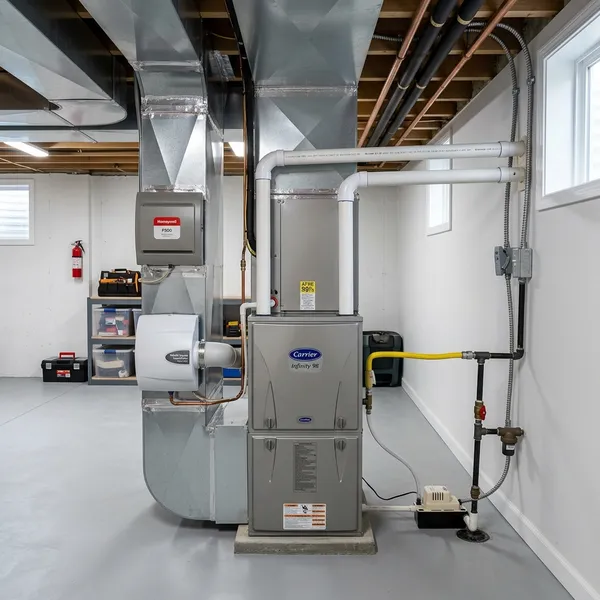
Every furnace issue requires a specific technical solution. Whether troubleshooting an active emergency breakdown, planning a high-efficiency system upgrade, or replacing an obsolete unit, our specialized service pathways deliver targeted care.
When your furnace stops heating, starts making screeching sounds, or repeatedly trips your breaker, our factory-trained technicians arrive fast with fully equipped mobile units. We pinpoint electronic ignition failures, clean soot-covered flame sensors, test blower motor run capacitors, clear restricted condensate lines, and inspect heat exchangers for microscopic cracks that risk carbon monoxide leakage.
Installing a residential furnace requires accurate engineering, not guesswork. We perform comprehensive Manual J load calculations to match your home's square footage, ceiling heights, window orientations, and insulation levels to the ideal BTU output. We design and install high-efficiency two-stage and modulating gas furnaces achieving up to 98% AFUE efficiency, ensuring whisper-quiet comfort and massive utility savings.
When an older furnace reaches 15 to 20 years of service, constant breakdowns and declining energy efficiency make ongoing repairs financially impractical. We handle complete turn-key furnace replacements, safely decommissioning obsolete units, upgrading intake and exhaust lines, transitioning chimney flues to PVC direct vents, and configuring smart zoning controls to eliminate cold rooms forever.
Forced-air furnaces heat more homes in Delmont than any other heating system. Knowing the mechanical operation of each component helps you recognize symptoms before an inconvenient mid-winter breakdown occurs.
When your home thermostat detects temperature dropping below setpoint, it sends a 24-volt call to the furnace control board. The draft inducer motor activates first, establishing negative pressure in the flue to pull fresh combustion air and expel dangerous exhaust gases safely.
Once the pressure switch confirms draft suction, the hot surface igniter glows red hot (reaching over 2,000 degrees Fahrenheit). The gas valve opens, releasing natural gas across the burners. The microamp flame sensor instantly verifies ignition; if flame is undetected within 4 seconds, the valve snaps shut for safety.
Burning fuel travels through the serpentine pathways of the primary (and secondary condensing) heat exchanger. The metal tubes become intensely hot, while toxic combustion gases remain safely sealed inside, heading outward through your home venting pipe.
After a 30 to 45 second warm-up delay, the blower motor activates. It draws cool household return air through your filtration media, pushes it across the exterior of the hot heat exchanger, and delivers comfortable warm air through supply registers in every room.
Furnaces endure tremendous thermal and electrical stress during harsh Pennsylvania winters. Our technicians carry specialized digital diagnostic gear to isolate and resolve these frequent failure points quickly.
The flame sensor is a thin metallic rod sitting directly in the burner flame. Over time, burning hydrocarbons leave an invisible layer of microscopic silica and carbon oxidation. When this occurs, the sensor cannot conduct the microamp signal back to the board. The furnace lights for 3 to 5 seconds and immediately shuts down. Our technicians cleanly polish the sensor with specialized non-residual emery cloth or replace degraded units.
Modern furnaces utilize silicon carbide or silicon nitride igniters that glow red hot to ignite natural gas. Because they endure rapid temperature swings from room temperature to 2,200 degrees Fahrenheit several thousand times each season, they eventually develop hair-line fractures and burn out. We test electrical resistance with digital multimeters and install robust replacement igniters.
The run capacitor supplies the electrical phase shift necessary to keep your blower motor spinning smoothly. As capacitors age, their microfarad capacitance drops. When it falls below 10% of rated tolerance, the motor overheats, hums loudly, struggles to start, and eventually trips internal thermal overload protections. We stock OEM dual and single capacitors for prompt on-site replacement.
If airflow across the furnace heat exchanger is choked off by a heavily soiled filter, closed supply dampers, or blocked return registers, the plenum temperature skyrockets beyond safe limits. The bimetallic high-limit safety switch opens, cutting power to the gas valve while leaving the blower on. Repeated cycling can permanently weaken the switch, requiring professional recalibration and replacement.
The draft inducer fan is exposed to hot, corrosive flue gases. Over years of use, its sealed ball bearings dry out, leading to screeching, rattling, or whining noises during start-up. If the inducer motor fails to reach sufficient RPM, the safety pressure switch will not close, preventing the furnace from ever firing up.
The most hazardous furnace failure. Over decades of metal expansion and contraction, metal fatigue causes fractures along heat exchanger seams or burner eyelets. This creates a critical safety hazard by allowing deadly carbon monoxide and combustion exhaust to mix directly into the breathable indoor air stream. We perform high-definition camera boroscope inspections and combustion analysis to identify these risks.
Natural gas costs represent a major portion of winter utility expenditures for Westmoreland County households. Annual Fuel Utilization Efficiency (AFUE) dictates exactly how much heat is delivered into your living areas versus lost up the exhaust flue.
| Efficiency Tier | AFUE Rating | Heat Delivered vs Wasted | Venting Technology | Est. Annual Fuel Savings |
|---|---|---|---|---|
| Legacy Atmospheric | 65% to 75% AFUE | 65 to 75 cents heat, 25 to 35 cents lost | Natural masonry chimney draft | Baseline (Highest Bills) |
| Standard Modern | 80% AFUE | 80 cents heat, 20 cents lost | Induced draft metal B-vent | 10% to 15% savings vs legacy |
| High-Efficiency Condensing | 95% to 98% AFUE | 95 to 98 cents heat, only 2 to 5 cents lost | Direct PVC side-wall venting | 25% to 35% monthly savings |
Standard 80% furnaces vent exhaust gases at temperatures exceeding 400 degrees Fahrenheit, discharging hot air and unharvested water vapor directly into the outdoor atmosphere. In contrast, high-efficiency 95%+ condensing furnaces redirect exhaust into a secondary stainless steel heat exchanger. This secondary chamber extracts the latent heat from the water vapor, cooling exhaust down to approximately 110 degrees Fahrenheit so it can be safely vented through inexpensive PVC piping. For a Delmont family spending $1,800 annually on winter heating, upgrading to a 96% AFUE furnace can save $400 to $600 each and every winter season.
Many heating contractors use lazy "rules of thumb" or simply replace an old 100,000 BTU unit with another 100,000 BTU furnace without evaluating home thermal dynamics. Oversizing or undersizing a furnace creates persistent operational problems.
Over 80% of emergency furnace calls during winter could be prevented with an annual autumn inspection. Our certified technicians complete this rigorous 21-step checklist on every seasonal tune-up.
Regardless of what brand furnace heats your home, our certified technicians carry universal diagnostic tooling and OEM components for prompt, warranty-protected repairs.






Also servicing Carrier, York, American Standard, Ruud, Heil, Coleman, and Armstrong Air heating equipment.
Based on 123+ local reviews
"Caleb performed a thorough check of my furnaces in Delmont. I always trust the work this team and their technicians do. Arrived right on time and explained everything clearly."
"I was very satisfied and pleased with all the work done by Caleb and Brett. I needed a large variety of heating jobs done and each one was completed cleanly without any mess."
"They were able to get us in fast even though it was really hot outside and they were extremely busy. Great job! I would definitely use them again for our residential cooling needs."
Expert answers regarding furnace repair diagnostics, sizing, emergency response, and energy efficiency.
Our local technicians are based directly in Delmont, PA on West Pittsburgh Street, allowing us to arrive at your doorstep swiftly for scheduled maintenance and 24-hour emergency heating or cooling response across the Route 66 and Route 22 corridors.
Delmont
PA 15626
Export
PA 15632
Murrysville
PA 15668
Salem Township
PA 15626
Slickville
PA 15684
New Alexandria
PA 15670
Penn Township
PA 15644
Apollo
PA 15613
Washington Township
PA 15613
Upper Burrell
PA 15068
Monroeville
PA 15146
Westmoreland County
PA 15626
Call our Delmont office to verify immediate technician availability in your neighborhood.
Submit your inquiry below for fast scheduling or upfront quotes. For immediate 24-hour emergency heating calls, please call (724) 482-3703 directly.
Centrally located on West Pittsburgh Street near Route 66 and the Route 22 corridor, our mobile service trucks are serving homeowners directly across Delmont, Export, Murrysville, Salem Township, and throughout Westmoreland County.
Our residential furnace technicians are ready for emergency response across Delmont and Westmoreland County. Call (724) 482-3703 now for flat-rate, guaranteed heating solutions.